In class we discussed the changes that happened in the late 19th century as a result of social Darwinism and a growing interest in finding the true essence of humans and with the ordinary life. This time period was moving away from the individual and the idea that we are in control of our own lives and actions. Instead there was the idea that we are simply controlled by our instincts and desires. All humans could be reduced to a type.
In Stephen Crane's and Edgar Allan Poe's stories they both focus on this kind of human reductionism in two different ways. Crane focuses on the basic stereotypes that all people can seemingly be based off of. In Poe's case he lakes this reduction literally to portray much the same thing.
In Crane's story we see a number of stereotypes listed, almost purposely it seems, in each story. The one that struck me the most was "When a Man Falls a Crowd Gathers" where is begins almost immediately with an Italian stereotype that still persists today. The man and boy are described making "quick egotistical gestures" as they speak (Crane 201). As discussed in class there is also a sense of automated movement and action as if you programmed a robot to be Italian in the simplest of terms. The Italian doesn't speak words but rather "syllables" as if it is just a jumble of sounds strung together that resembles language. Crane continues using specific ethnicities throughout the rest of the stories including Mexicans, Cubans, and Irish.
Something interesting to note about these characters is that they are very rarely, if ever, given a name. They are the "Mexicans" or "Cuban" as if that is all that is needed to described them. This is done other ways too by simply calling characters "Kid" or "general" throughout the text. What do you think is the purpose of this is? How does this reflect the views becoming dominant in the 19th century?
In Poe's story we get something a little more surreal than Crane's realist narrative about a general that has literally been whittled down into parts. Something I found interesting however was the narrators attempts at finding the essence behind General John A.B.C. Smith. He attempts to talk to five different people about this mysterious man and they literally all reply with the exact same thing. "Smith? Why not General John A.B.C.?" they all say and then continue talking with variations of what was said at five other times. It is almost automatic. Like they are programmed to say the same things.Can you connect this scenario to things you have observed about others? Why might they have all said roughly the same thing? Why do you think Poe decided to include this repetition?
Thursday, February 25, 2016

Tuesday, February 23, 2016
"Creaturely" and our vocabulary for scents
Since our discussion yesterday, I’ve been thinking about
smells. Partially because Elizabeth brought up that Twenty One Pilots song with
the lines: “Sometimes a certain smell will take me back to when I was young /
Howcome I’m never able to identify where it’s coming from?” and that song is a tune, but partially because it’s strange
to me how dull our capacity for olfactory sensory experience—as humans, at
least—is from other animals.
Friday, February 19, 2016
She thinks she's people
Something I've been thinking about a lot lately. Timothy Treadwell, in my humble opinion, acted like he thought he was a bear. "No human should ever be here" while he was forty feet away from fighting bears and whatnot. He also treated the bears like they were people: he gave them names and developed narratives to describe their behavior in terms that people could understand. So clearly the bear-human distinction is fuzzy when it comes to him, but he recognizes that these bears are different from other humans. He alone is special enough to go out and live with these bears and not get eaten... not that it turned out that way, but it seems to me that's what he thought.
It's understandable. Bears have much simpler lives than humans do. Bears don't have to worry about taxes and capstones. Being human kind of sucks, in that way. Whenever I see a dog, I think "man, I wish I was a dog."
A behavior that I don't understand, in which I even participate, is creating a narrative for animals that makes them out to want to be people. For instance, Treadwell creating stories about drama between the bears and naming their clam-digging techniques. The bears may realize they have different ways of opening clams, they may have taught each other different techniques and all that... they may not have. They may have just approached the problem differently, not really thinking about other ways to open a clam. Why would a bear want to give labels to different techniques, especially if they aren't all that different, and the difference between them has no impact on their lives? It's a pretty human thing to do.
People also really, really like to do this with dogs. I have invented a sassy personality for my dog so I can have meaningful conversations with her. She likes hams and is afraid of squeaky toys. She thinks the world revolves around her. I notice, though, that her 'voice' always wants to be human. Why on earth would my dog want to be human? She gets to nap all day, she gets snuggles and food and ham cubes, she has lots of toys and if she goes up to anyone she gets pats and playtime. I invent that my dog is jealous of my opposable thumbs and ability to reach the bag of treats, because that is something I have that she does not, but it's very convoluted. As a human, I can imagine a dog wanting to be a human, so she can have access to the dog things that humans control for her, but I cannot think of a single human thing that a dog would want out of being human. As a human, I personally would really like to be a dog instead, so I wouldn't have to, um, DO anything.
But we continue! My dog 'thinks she's people,' because she shies away from other dogs at the dog park and clings to me. She has claimed the best spot on the couch for watching TV, because she clearly has a deep understanding of that. I guess we do this to make ourselves feel better about our human lives compared to how we perceive animal lives. If an animal who pretty much has it all is jealous of something we have, then that must be a marker that we are the superior species, even if what we have is of no benefit to us.
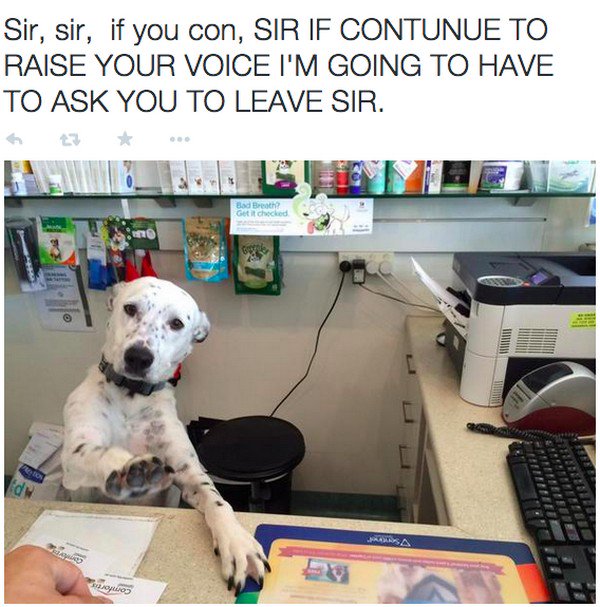 |
| This dog is living the good life, whether that life is disciplining rude customers or jumping up to see people that might give him food and affection. |
Monday, February 15, 2016
Grizzly Man Diaries
In class we discussed how we treat animals based on our sense of ethics and justice.
When Timothy Treadwell died at the hands of a grizzly, a group of men armed with guns went out after the bear that killed him and his girlfriend, and dealt the bear some swift buckshot justice.
Let's imagine a scenario where this is a person, and not a bear. In this scenario, let's say that there is a person that has taken to squatting in a house. This person does not own the house, but this person has grown to become territorial over it. One day, this squatter finds some punk in his squatter spot. In split second moment of rage, the squatter attacks this punk, and ends up killing him unintentionally. Unfortunately for the squatter, this punk has connections, and it doesn't take long for the law to start running him down.
Unlike the bear, the squatter has a shot at being taken alive, while the bear was always doomed to die before given a chance at a trial. I believe that part of this has to do with the fact that those that went after the bear believed that a bear is only capable of reacting, with no ability to respond to situations. The squatter on the other hand, has the ability to make a reasonable response to the situation, but doesn't in favor of making a knee jerk reaction of finding someone invading his space. The ability to respond implies an ability to know right from wrong, so if a bear is perceived as being incapable of responding that makes them inherently dangerous. The squatter on the other hand, while having been proven dangerous in once instance, is not inherently dangerous, and is more likely to safely be taken alive.
The question to be raised here is if it's really fair that a human will usually receive better treatment than a bear or any other dangerous animal. Is it possible to capture a bear alive, and if so, does it make sense to do so? Should humans make every attempt to ensure that bear receives the same sort of justice that a human might?
Thursday, February 11, 2016
Humanimal and Singh
I went on a GO Fellowship to Ecuador this past summer and spent two full months working at a daycare for children and young adults with special needs from underserved communities in the city of Quito. My first day at the facility was a very interesting day filled with lots of dizzying activity and introductions lost in translation (my Spanish was a little rusty in the beginning of my trip, which certainly did not help). Although the first day at the facility was very disorienting, I will never forget a certain kid that I had encountered—Juan.
Thursday, February 4, 2016
The Animal That Therefore I Am
Derrida is rather tough going, but he is also one of the very most influential philosophers of the last 50 years and hugely influential on literary studies. Have any of you encountered him or his ideas before? A big part of what makes Derrida difficult is his distinctive style. He writes in an elliptical, persistently deferring style in which ideas seem to keep slipping away into other ideas. This is purposeful. For example, he keeps using the phrase "that which we call animal" instead of the more straightforward term "animal." Think about the difference. The word "animal" appears to name things in a final way: the familiar name stops our thinking. By contrast, the phrase "that which we call animal" slows us down, it calls our attention to our own process of naming and knowing, and it recalls us to that moment of encounter with the animal before we have named it (that is, before we think we know what it is). The best way to read Derrida, then, is to follow his invitation and to think slowly. Try to focus on the particular way he frames ideas and practice thinking in those terms as well. He tends to ask questions more than he answers them, so
Discussion Leader Schedule
Here is the schedule for Discussion Leaders for the first half of the semester. Sign up by writing a comment below -- first come, first served. If you haven't picked one by next week, I will start assigning them. For your post, focus on the writer you signed up for, but you are welcome and encouraged to make connections with the other material as well.
Week 2
Monday: [Greg Kinzer - Derrida & Pettman]
Wednesday: [ Nicole - Humanimal and/or Singh]
Week 2
Monday: [Greg Kinzer - Derrida & Pettman]
Wednesday: [ Nicole - Humanimal and/or Singh]
Week 3
Monday: [ William - Pettman and/or The Grizzly Man Diaries]
Wednesday: [____________ - Humanimal and Sontag]
Week 4
Monday: [Emily Spears - "Creaturely"]
Wednesday: [Emily Atkins - Selzer and either Stephen Crane or Edgar Allen Poe]
Week 5
Monday: [____________ - McTeague]
Welcome to Our Blog
Hi everyone. The goal of this blog is to create an interactive and communal space where we are actually reading each others' ideas and commenting back and forth. It will be a great resource for us to review material and get new ideas for our papers. It's private and read only by us, so feel free to explore.
I assume the basic format and mechanics of this are familiar enough. You can do two basic kinds of things: 1) comment on a post, and 2) make a new post. When you want to comment on what someone else has written, extend an existing idea, or ask a question about it, write a "comment." When you want to start a new topic of discussion, use "new post." Be sure to title your new post with something simple and clear, so we can easily see what the topic is -- and so we can go back and find old posts easily.
Discussion Leaders: When it is your turn to lead discussion, you should make a "new post." The goal of your post should be to start a conversation. Point us to a specific part of the text that seems important. Think critically. Ask us questions -- real questions, that you would really like others to try to help you answer. Build on things we talked about in class. Think about the three basic reading questions outlined on the syllabus (how does this theory compare to other theories? what is this theorist trying to do? how does this theory help you think about literature differently?). Be sure to use the author's name, title, and citations correctly. Your post should be a page or so in length. So we can see everyone's post more easily, insert a "jump break" about five lines into your post. (The "jump break" button is in the format bar just above where you are typing, beside the movie icon. Just click the button to insert.) As discussion leader, your post is due within 24 hours of class, either before or after. (I.e. If you are leading discussion for Wednesday's class, then you must post sometime between Tuesday afternoon and Thursday afternoon.)
Everyone: You should be reading the blog and commenting every week. You can make one or two big comments, or several smaller ones. I'd love for us to be commenting back and forth, and to actually be having a conversation online. As you comment, really read and respond to the ideas the discussion leaders are posting. Try to answer their questions. Clarify or build on their explanation of key ideas. Extend their thinking. If you have a different idea you want to explore and want to start a new topic, you are also always welcome to make a "new post." Your comments should average to a page or so per week
Remember, the Blog is worth 20% of your grade.
Subscribe to:
Posts (Atom)