It's understandable. Bears have much simpler lives than humans do. Bears don't have to worry about taxes and capstones. Being human kind of sucks, in that way. Whenever I see a dog, I think "man, I wish I was a dog."
A behavior that I don't understand, in which I even participate, is creating a narrative for animals that makes them out to want to be people. For instance, Treadwell creating stories about drama between the bears and naming their clam-digging techniques. The bears may realize they have different ways of opening clams, they may have taught each other different techniques and all that... they may not have. They may have just approached the problem differently, not really thinking about other ways to open a clam. Why would a bear want to give labels to different techniques, especially if they aren't all that different, and the difference between them has no impact on their lives? It's a pretty human thing to do.
People also really, really like to do this with dogs. I have invented a sassy personality for my dog so I can have meaningful conversations with her. She likes hams and is afraid of squeaky toys. She thinks the world revolves around her. I notice, though, that her 'voice' always wants to be human. Why on earth would my dog want to be human? She gets to nap all day, she gets snuggles and food and ham cubes, she has lots of toys and if she goes up to anyone she gets pats and playtime. I invent that my dog is jealous of my opposable thumbs and ability to reach the bag of treats, because that is something I have that she does not, but it's very convoluted. As a human, I can imagine a dog wanting to be a human, so she can have access to the dog things that humans control for her, but I cannot think of a single human thing that a dog would want out of being human. As a human, I personally would really like to be a dog instead, so I wouldn't have to, um, DO anything.
But we continue! My dog 'thinks she's people,' because she shies away from other dogs at the dog park and clings to me. She has claimed the best spot on the couch for watching TV, because she clearly has a deep understanding of that. I guess we do this to make ourselves feel better about our human lives compared to how we perceive animal lives. If an animal who pretty much has it all is jealous of something we have, then that must be a marker that we are the superior species, even if what we have is of no benefit to us.
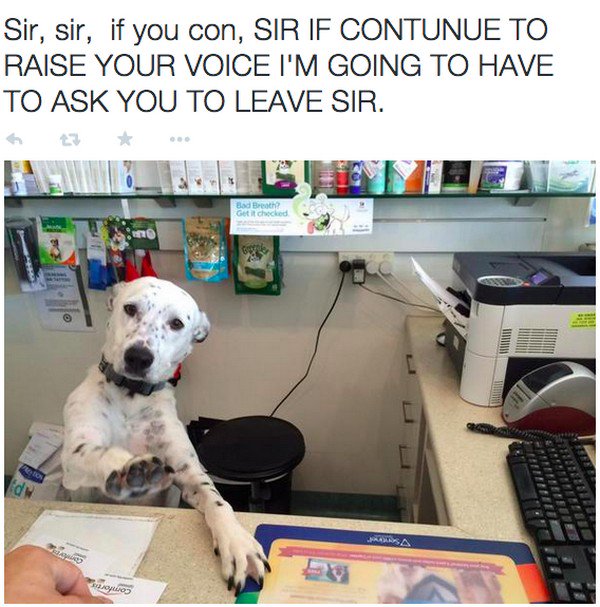 |
| This dog is living the good life, whether that life is disciplining rude customers or jumping up to see people that might give him food and affection. |

This is incredibly true and likely something to be seen with most pet owners, particularly cats and dogs I bet. Creating an almost human persona for your pets is just too tempting to not do. If my cat bullies the dog we say "Oh well she was jealous of the dog getting all the attention. That darn cat." I often call my cat a cranky old lady with a disdain for human and their silly lives. This is the voice I (and my parents) have created for Mittens.
ReplyDeleteI've had this cat since I was 6-years-old but for some reason I cannot recall giving my cat this kind of persona until I was a little older maybe around 11 or 12. I played with her and fed her and chased her around the house as any young pet owner would do. However, my mom would often talk about how the cat loved my dad more than anyone else in the house and how our cat would just be annoying for the sake of being annoying.
But now I begin to wonder when I began to think along those lines too? When I was six I never acted this way with my cat. She was just a fur ball that I could hug and play with. I never read any deeper into her actions or thought of her as disdainful of humans or some sort of evil mastermind. Beyond that I can't actually remember what I thought of my cat.
I did start giving her a personality though due to my mom who would often pretend talk as the cats inner voice in a silly voice for my amusement. Usually in some sort of hoity-toity European accent. I loved that and it usually made me laugh.
But in answer to your question I think that there a number of reasons we try to bring animals up to the human level is because we do want to understand them. When a dog barks we try to decipher what that bark means. We put it into human terms because that is what we understand. It wouldn't make sense for us to try and understand it in dog terms because we already don't understand dog. So we create a personality for our pets that we can associate with easier. Treadwell probably did this too so he could somehow feel closer to the bears. This could be an example of a poor-ontological-tourist that Pettman points out. You aren't really connecting with the other animal at all, just a superficial personality that you create.
But once again, I never really did that as a child. My cat was something that couldn't communicate with me in a way I understood but hell I loved cats so it didn't particularly bother me. Did anyone else have this sort of relationship with their pets? Is it possible that younger children have the potential of connecting easier with other animals? Connecting it back to class could this by why we see feral children like Amala and Kamala? Or am I just reaching too far?
Wow. Very, very interesting anecdote. It seems that as you got older, due to probably your parents' influence, you grew to be more humanistic. It makes sense because children tend to be more accepting of (or in some cases, completely oblivious to) differences between them and other humans and animals.
DeleteI actually never had this sort of relationship with my dog. I got him when I was in third grade and then he ran away right before I came to college (sad...). It could have to do with the fact that he was an outdoor dog, so there weren't as many chances for me to develop that humanistic sort of relationship with him. But I think that if I were to adopt another dog now, I would most-likely bestow human qualities on him in order to relate to him better.